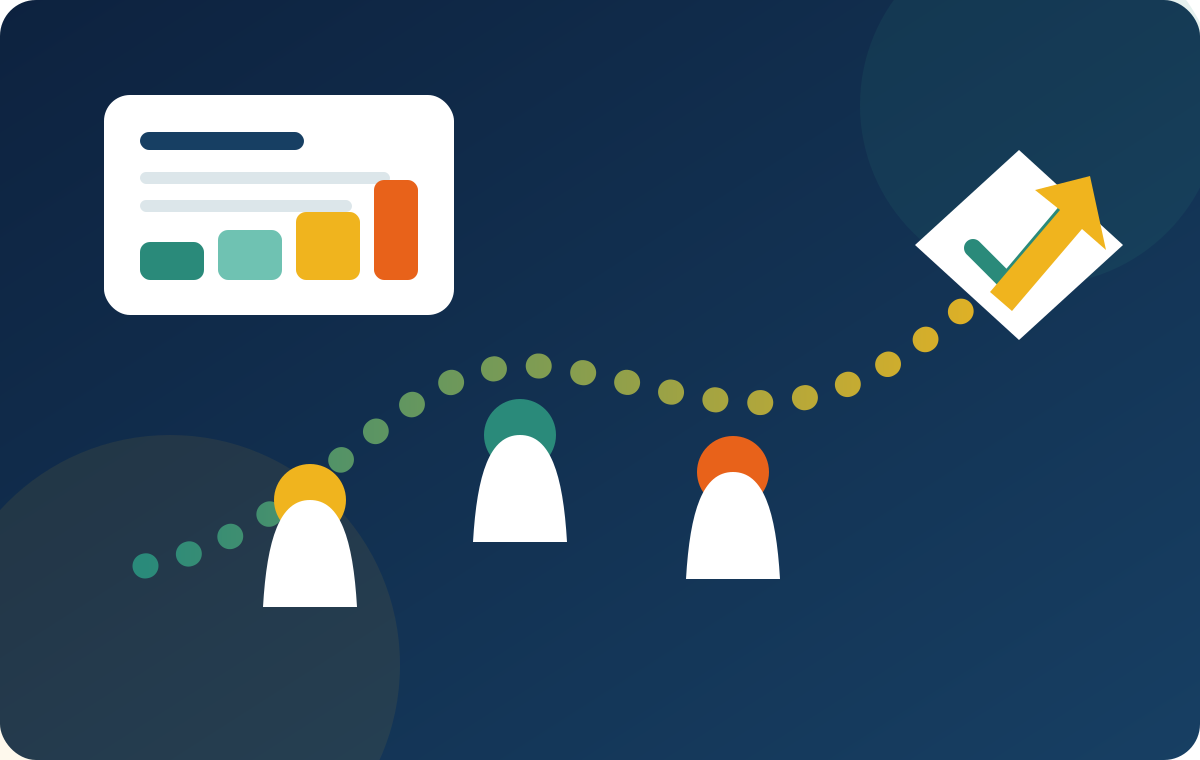
01 · Strategy to action
Closing the execution distance
Aligning priorities, decision rights and operating rhythms so the organisation can act on what leadership has already decided.
Novaris Transformation Lab is an OD and HR transformation practice. We work with leaders who have made decisions — about direction, structure, culture, talent — that the organisation has not yet fully enacted. We find out why, address the causes directly, and build the internal capability to sustain the shift after we leave.
We do not run separate workstreams. Every engagement begins with diagnosis, and the work that follows is calibrated to what the diagnosis actually shows — not to a pre-packaged service offering.
These original Novaris illustrations show the four movements we work through most often: turning intent into execution, diagnosing the real constraint, building leadership capability, and embedding change into everyday systems.
Aligning priorities, decision rights and operating rhythms so the organisation can act on what leadership has already decided.

Separating symptoms from causes and showing where structural friction is consuming organisational energy.

Equipping leaders and managers to translate direction into clear expectations, decisions and daily behaviour.
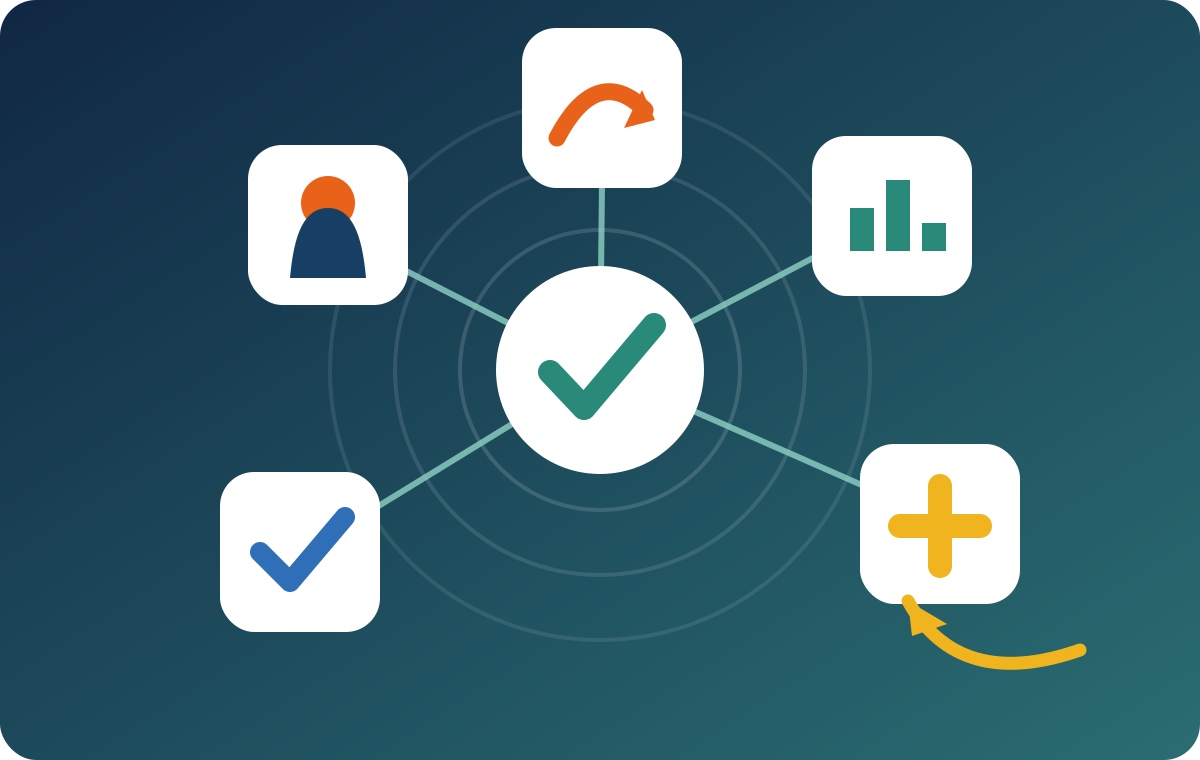
Embedding new behaviours into governance, measurement, accountability and routines so progress continues after the engagement.
Most organisational health surveys produce a single composite score. A high score is taken to mean the organisation is in good shape. A low score means it is not. We find this binary view insufficient for the actual work of change. An organisation can carry high levels of energy and commitment alongside high levels of structural friction — and these two conditions are not opposites. They are independent, they call for different interventions, and a single number cannot show you both.
The energy available for strategy execution: the degree to which people are aligned around a shared direction, engaged in the work, capable of adapting when conditions change, and willing to collaborate across boundaries. This is the fuel. It can be high or low regardless of how much structural friction exists.
The structural friction consuming that energy: ambiguous ownership of decisions, priorities that compete without resolution, governance processes that slow rather than enable, measurement systems that reward the wrong things, and accumulated complexity that makes the simple hard. This is the drag. It operates independently of engagement or intent.
If your organisation is highly energised but structurally chaotic, the right intervention is structural — clarifying ownership, simplifying governance, reducing competing priorities. Giving people a purpose workshop will not help. If your organisation is structurally orderly but low-energy, the right intervention is human — rebuilding engagement, addressing what has eroded commitment. Reorganising reporting lines will not help. The map shows you which quadrant you are in. The intervention follows from that.
NOVARIS PACES is the framework through which we assess and address the five conditions that determine whether a strategy becomes behaviour. Every transformation travels a distance — from the decision made in the boardroom to the action taken on the floor. PACES maps the conditions that determine whether it gets there. All five are active simultaneously. Weakness in any one creates a gap. We assess and strengthen whichever are weakest in your specific situation, working them together, not in sequence.
We do not begin with a proposal. We begin with a diagnostic. What the diagnostic shows determines what the engagement requires. Every phase has a deliverable. The final deliverable is a re-measurement, not a presentation.
These are the organisational situations where the distance between decision and reality tends to be widest — and where the work we do produces the clearest results.
mid-size consumer goods business — the gap between a board decision and operational reality.
The chief executive had made a clear decision: the business would shift from a product-led to a customer-led operating model. The decision had been made in the board, communicated in the all-hands, and discussed in every senior team meeting for eight months. At the operational level, the sales team was still being measured and rewarded on volume by product category. The operations team was still optimised for production efficiency rather than order flexibility. The customer service function did not have the decision authority to resolve anything above a defined value threshold without escalating. Nothing had structurally changed.
We ran ENTRONOVARIS across the senior, middle management, and operational populations. Vitality was high at the senior level — the leadership team believed in the direction and was committed to it. Entropy was severe at the operational level — the specific sources were measurement misalignment, decision authority gaps, and the absence of any cross-functional mechanism for resolving the conflicts that the new model was producing daily. We redesigned the performance measurement for the sales and customer service functions, established explicit decision authority at the operational level for customer-facing issues below a new threshold, and created a weekly cross-functional resolution process for the conflicts above it. We ran structured sessions with the operational managers to involve them in the final design of the customer resolution process before it was locked.
Performance measurement redesigned for sales and customer service. Explicit decision authority established at operational level for customer-facing issues below the new threshold.
Operational managers involved in the design of the customer resolution process before it was finalised. Re-measurement date agreed and scheduled before the engagement closed.
Written from the work. Not from the literature.
Short recordings on the themes we encounter most often — strategy execution, organisational diagnosis, and what it takes to make change hold. Practical, not theoretical.
The organisations we work with are not struggling because they lack ambition or because their leaders are not trying. They are struggling because the conditions around their people — the structures, the incentives, the decision rights, the way accountability is held — have not kept pace with the direction they have chosen. Closing that gap is specific, disciplined work. It is the only work Novaris does.
The ENTRONOVARIS diagnostic takes two to three weeks and produces a domain-level map of where the distance is greatest — and what is maintaining it. That is where every engagement begins.
Run the Diagnostic → NOVARIS
See how this applies in practice. Run an ENTRONOVARIS diagnostic first.
Run the Diagnostic →Our distinctive AI-style illustrations remain part of the Novaris visual identity. We have also added real professional photography to bring more humanity, credibility and warmth to the experience.
Photography: Pexels free-use licence.